How Speaking Enhances Memory: What Cognitive Science Reveals
Dec 1, 2025
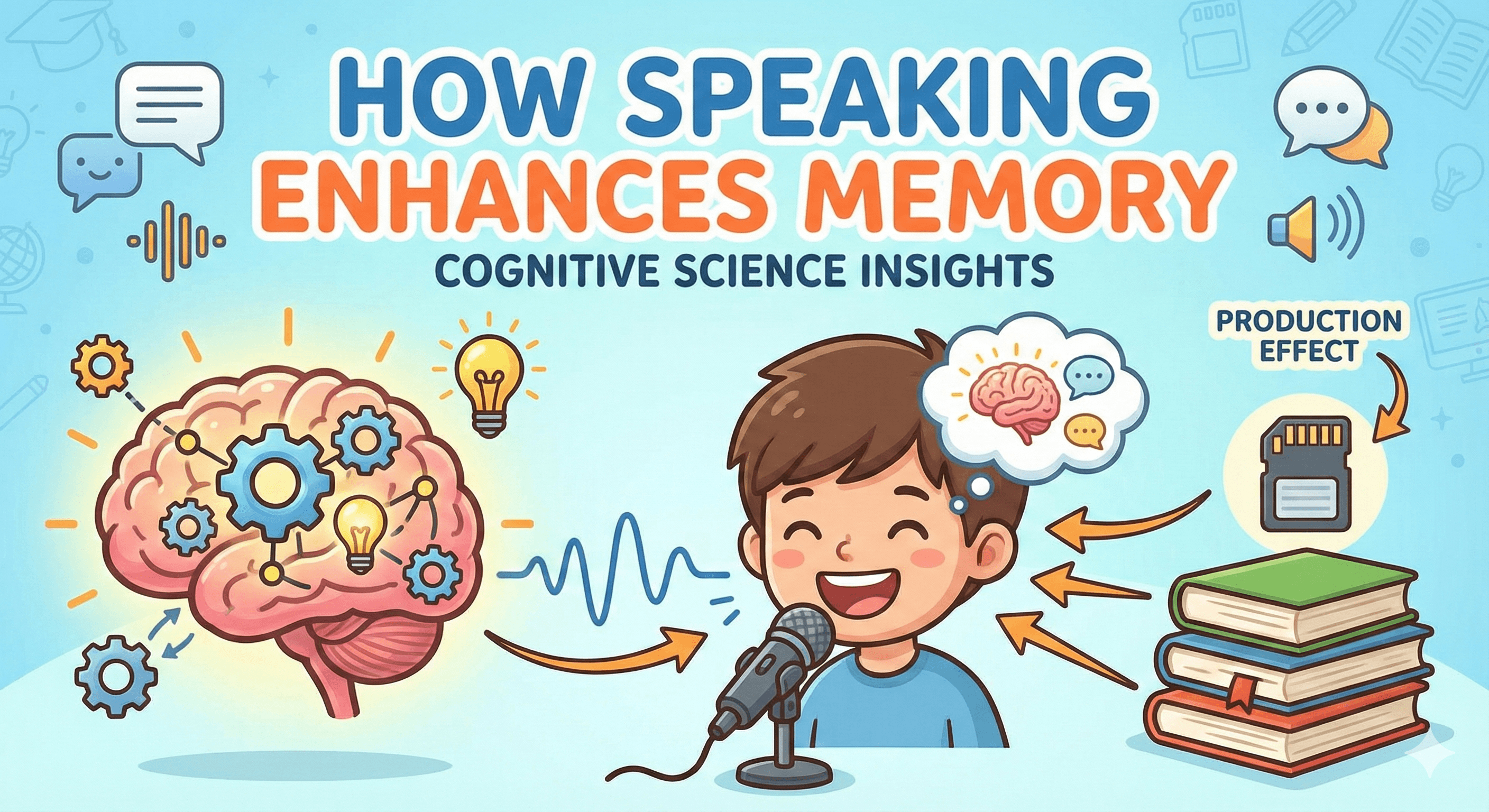
1. Why does speaking strengthen learning?
Speaking is not just an expression skill—it is a powerful memory enhancer.
When children speak, their brains activate:
phonological systems
auditory feedback loops
motor regions for articulation
working memory for organising thoughts
This multi-system activation leads to deeper encoding and more durable memory traces.
2. The Production Effect: Saying it out loud boosts memory
What is the Production Effect?
The Production Effect states:
Words spoken aloud are remembered better than words read silently.
Studies at the University of Waterloo show that reading aloud produces higher recall scores because:
speaking creates multisensory encoding
spoken items become more distinctive in memory
Neuroscience behind it
Speaking activates:
Broca’s area
auditory cortex
motor cortex
hippocampus
This creates stronger memory consolidation compared to silent reading or listening.
3. Uniqueness & Retrieval: Why spoken information becomes hard to forget
1. Spoken moments feel “unique” to the brain
When a child says something out loud:
the sound of their voice
the movement of their tongue
the emotional tone they use
all form a personal, unique memory trace.
2. Retrieval Practice strengthens memory
Retrieving information through speaking—such as answering questions or retelling a story—acts as a memory booster.
Each retrieval:
deepens memory
increases long-term retention
improves flexible use of knowledge
4. Applying speaking-based memory strategies in language learning
1. Reading aloud vs playing audio
Children remember more when they:
speak words
repeat sentences
hear themselves talk
The combined effect strengthens vocabulary and grammar retention.
2. Speech-enabled learning apps
These apps encourage:
describing pictures
answering questions
restating sentences
using voice to complete challenges
All of which leverage the Production Effect.
3. Especially effective for auditory learners
Auditory learners benefit greatly from hearing their own voice, showing up to 20% improvement in recall.
5. Practical tips for parents & educators
1. Ask children to retell stories
Examples:
“What surprised you the most?”
“Tell me what happened in your own words.”
“How would you change the ending?”
This uses retrieval practice to deepen memory.
2. Let them become the “mini teacher”
Teach-back methods help solidify:
vocabulary
concepts
story structures
3. Use speech-based apps
Apps that require speaking to progress help children practise without fear of judgment.
6. Conclusion: Children remember what they say
In short:
Heard once = may remember
Read once = might remember
Said once = far more likely to remember
Speaking transforms passive input into active, long-lasting memory, making it a powerful tool in children’s language development.
References
MacLeod & Bodner – The Production Effect in Memory
https://uwaterloo.ca/memory-attention-cognition-lab/sites/default/files/uploads/files/macleodbodner_cdps17_0.pdfFrontiers in Psychology – The Production Effect in Memory
https://www.frontiersin.org/articles/10.3389/fpsyg.2014.00886VARK Learning Guide – Auditory learning
https://vark-learn.com/introduction-to-vark/Retrieval Practice Research (Agarwal & Bain)
https://www.retrievalpractice.org/researchLearning Scientists – Six Strategies for Effective Learning (Retrieval Practice)
https://www.learningscientists.org/effective-learning-strategiesWikipedia – Production Effect overview
https://en.wikipedia.org/wiki/Production_effect