From Passive to Active: How Speaking Interaction Transforms Children’s Learning
Dec 1, 2025
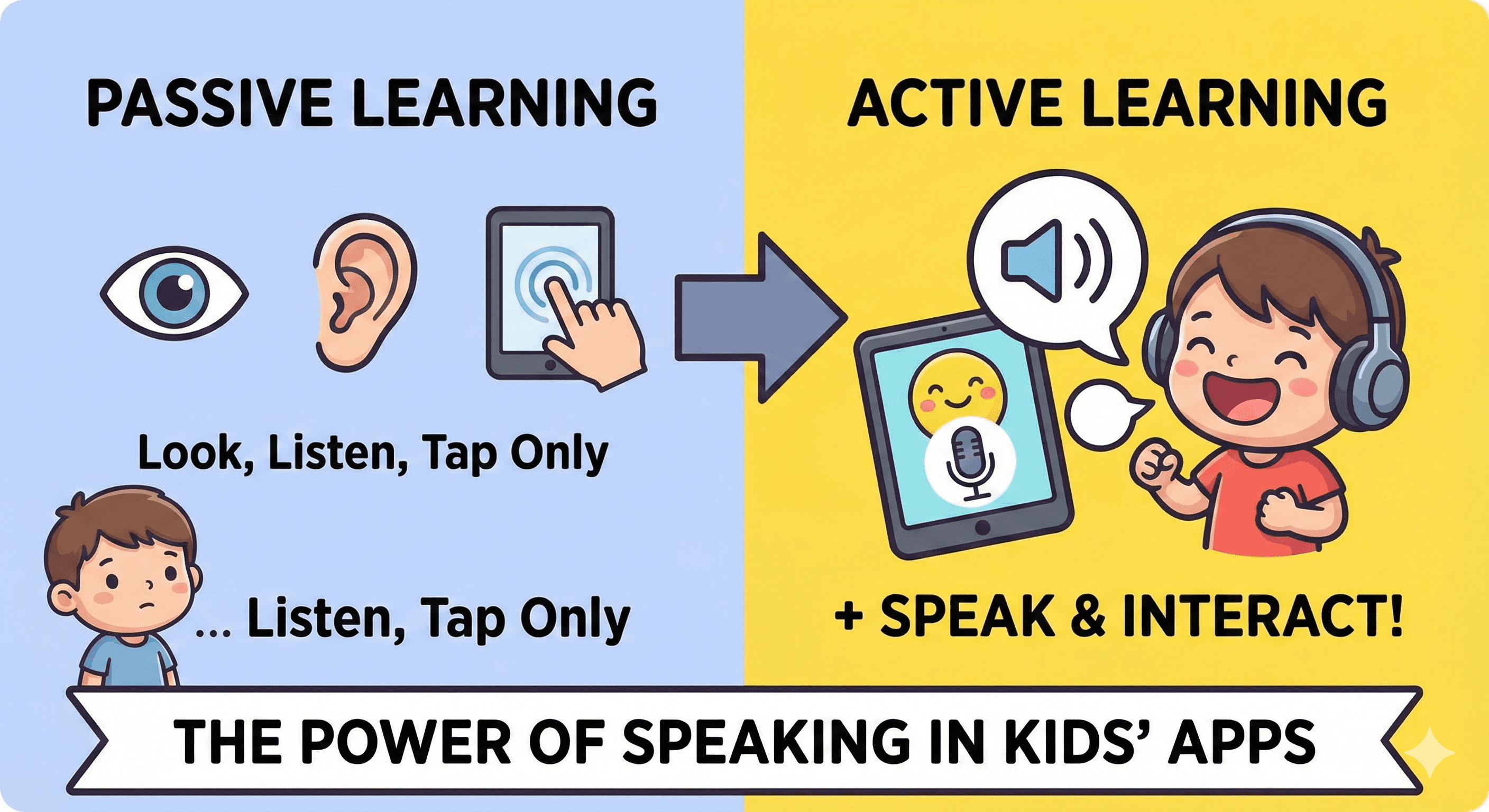
1. Why move from “look–listen–tap” to “look–listen–tap–and speak”?
Most children’s learning apps used to stop at three actions:
look at the screen → listen to the audio → tap the right option.
This is more engaging than a worksheet, but the child is still mostly a passive receiver of information.
With recent progress in speech recognition and text-to-speech, more children’s apps now invite kids to:
say answers out loud
talk to on-screen characters
read stories or sentences aloud
unlock levels by using their voice
In other words, we are moving from “look + listen + tap” to
“look + listen + tap + speak”,
turning children from silent observers into active participants in the learning experience.
2. The limits of passive learning: “I understand, but I can’t say it”
In many classrooms and apps, we see the same pattern:
Children understand the story but are rarely asked to retell it
Most tasks are multiple choice or drag-and-drop
Everything seems smooth during the lesson, but a few days later they remember very little
Passive learning tends to keep children stuck at:
Input without output
They receive a lot of information but rarely have to use it
Language stays at the level of “I recognise this” instead of “I can use this”
Little need to think or organise ideas
They don’t have to structure their thoughts in words
Critical thinking and application remain underused
Learning that’s hard to “see”
A correct tap doesn’t always mean real understanding
Adults get few chances to hear what the child truly knows
Research in education shows that students often feel they learn more from traditional lectures, but actually learn more in active-learning environments where they must think and participate.pnas.org+2ScienceDaily+2
3. What is active learning, and why is speaking so powerful?
Active learning means learners are mentally and often physically engaged in making sense of ideas, not just listening.
From the perspective of Bloom’s taxonomy, active learning pushes students beyond remembering facts toward understanding, applying, analysing, evaluating, and creating.cambridgeinternational.org
In language learning especially:
Listening and reading = input (taking information in)
Speaking and writing = output (working information out)
When we ask children to speak, several important processes kick in:
3.1 Deeper processing
To speak, children have to:
recall what they’ve just seen or heard
pick suitable words from memory
put those words into a sentence
express it within a short time frame
This slightly effortful process strengthens understanding and memory.cambridgeinternational.org+1
3.2 The “production effect”: saying it out loud helps memory
The production effect in cognitive psychology shows that items read aloud are remembered better than items read silently.uwaterloo.ca+1
When children read or repeat something out loud, their brains:
engage visual, auditory, and motor speech areas at the same time
treat those spoken items as more distinctive in memory
So when a child says a sentence into the app instead of just reading it silently, they add an extra “tag” in memory – making it easier to recall later.
3.3 The Output Hypothesis: noticing gaps while trying to speak
Merrill Swain’s Output Hypothesis argues that when learners try to speak or write, they notice gaps between what they want to say and what they can say, and that awareness drives further learning.維基百科+2SpringerLink+2
For children, this looks like:
“I want to say ‘I had fun at the park yesterday’ but I don’t know how to say ‘yesterday’ in English.”
That moment of frustration becomes a powerful trigger to ask, search, and truly learn.
4. What does speaking interaction look like in children’s apps?
Here are three common and effective patterns for speaking-based interaction:
4.1 Story + comprehension questions
The app plays a picture book or short story
Then it asks questions like “Who is the main character?” or “What happened at the end?”
The child answers in their own words; the system listens for key ideas and gives feedback
Result:
This checks understanding, not just listening
Children practise summarising and retelling, not only recognising
4.2 Role-play dialogues
The child plays a role in a story
When it’s their turn, they speak their line into the microphone
The app rewards complete sentences, not just single words
Result:
Simulates real communication rather than isolated drills
Helps children experience language as a tool for interaction
4.3 Voice-powered quests
Saying a word correctly opens the next door
Reading a sentence aloud launches the rocket or casts the spell
Result:
Speaking becomes an essential part of gameplay, not an optional extra
Reduces “random tapping to rush through levels”
5. What does the research say?
A few key strands of evidence support designing for speaking-based, active learning:
Active learning vs. traditional lecture
A Harvard study in PNAS showed that students in active-learning classes learned more, even though they felt like they learned less compared to lecture-based classes.pnas.org+2ScienceDaily+2
Speaking strengthens memory
Production-effect studies consistently find better recall for items produced aloud than silently read items.uwaterloo.ca+1
Output helps language development
Swain’s Output Hypothesis and later work suggest that producing language pushes learners to refine grammar and vocabulary in ways that input alone cannot.維基百科+2SpringerLink+2
Active, playful learning supports children’s development
Recent research links active, playful learning to gains in children’s cognitive, social, and emotional outcomes.ScienceDirect+1
Speaking opportunities matter in children’s language classes
Organisations like the British Council emphasise pair work, games, and speaking activities to maximise children’s talking time and confidence.britishcouncil.sg+3LearnEnglish - British Council+3TeachingEnglish+3
6. Practical ideas for parents, teachers and designers
For parents
After a story, go beyond “Did you like it?” and ask:
“Which part made you happiest?”
“If you were the main character, what would you do?”
Encourage your child to retell the story in their own words
For teachers
Intentionally build in “children talk time”:
After matching words and pictures, ask them to make their own sentences
After watching a video, ask for three moments that stood out
Use pair and small-group speaking tasks to maximise speaking opportunitiesTeachingEnglish
For product teams
Make speaking part of progression (quests, levels, rewards), not a side feature
Give feedback not only on correctness but also on completeness of ideas and sentence use
Design short, focused speaking turns to respect young children’s attention spans
7. Conclusion: from “being taught” to “actively learning”
When children’s learning apps include speaking interaction, we’re not just adding a fancy feature. We are changing the learning role of the child:
From someone who is taught, to someone who is actively learning through speaking, thinking, and creating.
Evidence from research and classroom practice points the same way:
children who speak more, learn deeper, remember longer, and grow more confident.
That is the real power of moving from passive to active learning.
References
Deslauriers, L. et al. Measuring actual learning versus feeling of learning in response to being actively engaged in the classroom. PNAS.
https://www.pnas.org/doi/10.1073/pnas.1821936116 pnas.orgScienceDaily summary of the active learning study
https://www.sciencedaily.com/releases/2019/09/190905171810.htm ScienceDailyHarvard Physics – Lessons in Learning
https://www.physics.harvard.edu/news/2019/09/lessons-learning physics.harvard.eduCambridge Assessment International Education – Active learning
https://www.cambridgeinternational.org/Images/271174-active-learning.pdf cambridgeinternational.orgMacLeod & Bodner – The Production Effect in Memory
https://uwaterloo.ca/memory-attention-cognition-lab/sites/default/files/uploads/files/macleodbodner_cdps17_0.pdf uwaterloo.caFrontiers in Psychology – The production effect in memory: multiple species of distinctiveness
https://www.frontiersin.org/articles/10.3389/fpsyg.2014.00886 FrontiersWikipedia – Comprehensible output
https://en.wikipedia.org/wiki/Comprehensible_output 維基百科Shahini, A. – Output Hypothesis in Language Learning (Springer, 2025)
https://link.springer.com/chapter/10.1007/978-3-031-92210-7_6 SpringerLinkKrashen, S. – Comprehensible Output
https://www.sdkrashen.com/content/articles/comprehensible_output.pdf sdkrashen.comWeisberg, D. et al. – Investigating the contributions of active, playful learning to student interest and educational outcomes
https://www.sciencedirect.com/science/article/pii/S0001691823001592 ScienceDirectThe Benefits of Active Learning for Child Development – Global School of Intelligence
https://www.gsoi.ma/en/2025/08/01/active-learning-benefits-children/ gsoi.ma+1British Council – LearnEnglish: Practice English speaking skills
https://learnenglish.britishcouncil.org/skills/speaking LearnEnglish - British CouncilBritish Council – TeachingEnglish: Kids and speaking
https://www.teachingenglish.org.uk/professional-development/teachers/knowing-subject/articles/kids-and-speaking TeachingEnglishBritish Council – LearnEnglish Kids (for parents and children)
https://learnenglishkids.britishcouncil.org/ learnenglishkids.britishcouncil.orgBritish Council Singapore – How English language boosts early childhood development
https://www.britishcouncil.sg/blog/how-english-language-boosts-early-childhood-developmentbritishcouncil.sg